Strategic Corridors: A Comparative Analysis of the ASEAN EXPRESS and the Tanzania SGR Master Plan
Emanuel E. Saitoti* · August 21, 2026
Abstract
A Tale of Two Corridors
The 21st century is marked by a global resurgence in large-scale infrastructure projects, with railway networks serving as pivotal instruments of economic development, regional integration, and geopolitical influence.
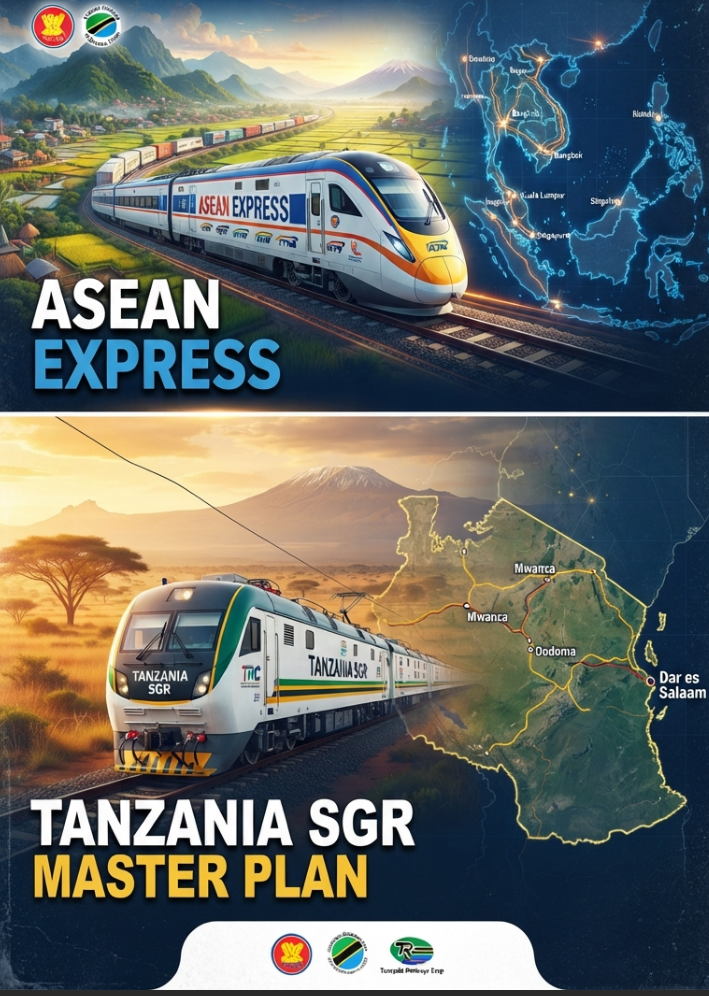
This report presents a comprehensive comparative analysis of two such initiatives: the ASEAN EXPRESS, a transnational rail freight service linking China to Southeast Asia, and the Tanzania Standard Gauge Railway (SGR) master plan, a national and regional project in East Africa.
While both projects are fundamentally driven by the ambition to modernize transport infrastructure and foster economic growth, their strategic objectives, financing models, and underlying geopolitical contexts diverge significantly.
The ASEAN EXPRESS is best understood as a critical component of a global power's geoeconomic strategy. It is an outward-looking initiative, designed to integrate Southeast Asia's burgeoning economies into China's industrial and commercial sphere.
A primary, long-term strategic objective is to create a robust land-based alternative to the Malacca Strait, a vital but vulnerable maritime chokepoint. The project's financing model, particularly evident in the foundational China-Laos Railway, is a classic example of China's Belt and Road Initiative (BRI) where significant debt is provided by a single foreign power. While this model has demonstrated rapid, tangible economic benefits for participating nations, it also raises concerns about debt sustainability and the potential for a compromise of national sovereignty.
In contrast, the Tanzania SGR master plan is an inward-focused, regional-power projection. Its core purpose is to establish Tanzania as the dominant economic and trade hub for East and Central Africa, replacing the outdated colonial-era meter-gauge railway and directly challenging Kenya's long-standing regional trade hegemony.
The project is a strategic effort by a sovereign nation to assert its own economic and political autonomy. This is reflected in its complex, multi-sourced financing model, which deliberately incorporates loans from a diverse array of international partners, including European and African financial institutions, in addition to Chinese firms. While this approach mitigates the risk of over-reliance on a single foreign power, it introduces its own set of challenges, including managing fragmented funding and navigating financial distress among key contractors, which can lead to project delays.
In essence, the ASEAN EXPRESS represents a paradigm where a global power uses infrastructure to extend its economic and political orbit. Conversely, the Tanzania SGR master plan exemplifies a paradigm where a regional power uses infrastructure to assert its own autonomy and project its influence within its sphere, consciously learning from the experiences of other nations with the BRI model.
This analysis reveals two distinct approaches to strategic development in a multipolar world, each with its own unique set of opportunities and risks for participating nations.
The following 2-slots provide a high-level summary of the key findings.
ASEAN EXPRESS
Feature: ASEAN EXPRESS
Goal: To integrate Southeast Asian economies into China’s sphere and create a strategic land-based trade corridor.
Key Countries: China, Laos, Thailand, Malaysia.
Financing Model: Primarily debt-based, with significant funding from China (BRI).
Operational Status: Freight service is operational, particularly on the China-Laos section.
Primary Challenges: The "break of gauge" bottleneck at the Laos-Thailand border. Geopolitical concerns over debt and sovereignty.
Geopolitical Context: A key component of China's global BRI strategy to secure trade routes and project influence.
Tanzania SGR
Feature: Tanzania SGR
Primary Goal: To establish Tanzania as the dominant regional trade and logistics hub for landlocked East African countries.
Key Countries: Tanzania, with links to Rwanda, Burundi, Uganda, and the DRC. Financing Model: Diversified, multi-sourced model involving various international lenders and contractors.
Operational Status: Under phased construction; some phases are nearing completion while others face funding and logistical challenges.
Primary Challenges: Funding gaps and financial distress of key contractors leading to delays. Complex management of multiple international partners.
Geopolitical Context: An explicit challenge to Kenya's regional trade dominance and a historical continuation of Tanzania’s strategy for economic liberation.
1. Introduction: The New Silk Roads of the 21st Century
The early 21st century has witnessed a global pivot toward infrastructure development as a primary tool for geopolitical and geoeconomic strategy. Nations are not merely building roads and railways to facilitate domestic commerce; they are constructing vast, multi-billion-dollar corridors to reconfigure global supply chains, secure strategic lifelines, and project power. These projects, often referred to as "New Silk Roads," symbolize a new era of connectivity where physical infrastructure is inextricably linked with foreign policy and regional power dynamics.
This report is designed to provide an expert-level, detailed, and nuanced comparison of two of the most significant and ambitious of these projects in different parts of the world: the ASEAN EXPRESS and the Tanzania Standard Gauge Railway (SGR) master plan. Geographically distant, these two initiatives offer a compelling contrast in their strategic drivers, financing mechanisms, and the distinct roles they play in their respective regions.
The analysis goes beyond a simple recitation of facts to explore the deeper implications of each project. It examines the historical context that has shaped their vision, the complex interplay between their stated economic goals and their underlying geopolitical ambitions, and the different risk profiles associated with their varied approaches to financing and implementation.
By structuring the report to first analyze each project individually and then conduct a comprehensive comparative analysis, this document aims to provide a clear and actionable understanding for a sophisticated audience of policymakers, investors, and strategic analysts. The objective is to distill complex data into a cohesive narrative that not only describes what is being built, but also explains why, what it means for the regions involved, and how it fits into the evolving global landscape.
2. The ASEAN EXPRESS: A Pan-Asian Rail Link to China
2.1 Strategic Intent and Geopolitical Drivers

The ASEAN EXPRESS is not a recent, isolated undertaking but a modern manifestation of a century-old vision. The concept of a transcontinental railway network connecting Kunming, China, to Singapore and the rest of mainland Southeast Asia dates back to the early 1900s, proposed by the British and French colonial empires to link their various holdings. This vision, however, was repeatedly thwarted by international conflicts and political fragmentation throughout the 20th century. The idea was revived in the 1990s, with a renewed focus on regional integration among ASEAN nations.
The true impetus for the project's current acceleration, however, came with its formal incorporation into China's Belt and Road Initiative (BRI) in 2013. The ASEAN EXPRESS, as a key component of the Pan-Asian Railway Network, serves as the centerpiece of the BRI's China-Indochina Peninsula Corridor. This link is a core element of the colossal BRI framework, which seeks to invest in infrastructure across more than 150 countries to facilitate trade, economic development, and cultural exchange.
A central geopolitical driver for the ASEAN EXPRESS is China's strategic interest in mitigating its dependence on the Malacca Strait. This narrow waterway, situated between Malaysia and Indonesia, is a critical chokepoint for global shipping and a vital conduit for China's seaborne trade and energy imports. By developing a viable, high-capacity land route, the railway provides China with a crucial strategic redundancy, allowing it to bypass the strait and secure its trade lifelines against potential future disruptions. The construction of this overland corridor transforms a simple economic decision into a grand geostrategic imperative, aimed at enhancing China's long-term energy and trade security. The project, therefore, is not merely about fostering economic development in Southeast Asia; it is a foundational element of China's national security strategy.
2.2 Operational Status and Logistical Landscape
The ASEAN EXPRESS is now an operational freight service connecting Malaysia's Kontena Nasional Inland Clearance Depot in Selangor to the inland metropolis of Chongqing, China. The inaugural journey, which took place in late June and early July of 2025, demonstrated the route's viability, with a cargo of electronics and agricultural products making the journey in approximately nine to fourteen days. This represents a significant logistical improvement over traditional sea freight, which can take an average of fourteen to twenty-one days. The service is projected to reduce logistics costs for businesses and consumers by as much as 30 percent, and is already attracting interest from exporters of goods like Musang King durian from Malaysia to China.
A foundational component of the ASEAN EXPRESS is the China-Laos Railway, which has been operational since December 2021. This section has demonstrated its commercial success, becoming a vital link for the Lao economy. In the first five months of 2025 alone, the railway transported over 2.48 million tons of import and export cargo with a value of more than $1.4 billion, a 33.2 percent increase in value compared to the previous year. The variety of goods transported has expanded dramatically from just over 10 types at its inception to more than 3,000, including electronics, vehicles, and a vast array of agricultural products.
However, the notion of a "seamless" railway connection is complicated by a significant technical challenge: the "break of gauge" problem. The modern, BRI-funded China-Laos section of the line uses a 1,435 mm standard gauge track. In contrast, the older colonial-era railway networks in Thailand and Malaysia operate on a narrower 1,000 mm meter gauge. This incompatibility forces a time-consuming transfer of containers one by one at the Laos-Thailand border, a process that can take nearly two hours. This logistical bottleneck undermines the efficiency of the entire route and highlights that the grand vision of a fully integrated railway network is still a long-term aspiration, dependent on further infrastructure upgrades in countries like Thailand and Malaysia. The presence of this technical constraint demonstrates that even with a strong strategic vision, legacy issues can significantly impede the full operational potential of a new transport corridor.
2.3 Economic and Regional Impact
The ASEAN EXPRESS has already delivered tangible economic benefits to the countries along its route. For Laos, a historically landlocked nation, the railway has been a game-changer, transforming it into a "land-linked" economy. The railway has significantly boosted trade, especially for agricultural products, with fruit exports increasing by 62.8 percent in the first seven months of 2025 alone. Beyond trade, the project has created jobs in logistics and other sectors, increased incomes for farmers, and provided a powerful symbol of progress and regional connectivity. The railway has also made domestic travel faster, safer, and more convenient for citizens, boosting local tourism.
The economic model is largely centered on integrating Southeast Asian economies into China's industrial and consumer market. The railway facilitates the export of goods from Laos and other countries to China, while also enabling the transport of Chinese goods and components south through the region. This creates a powerful economic axis, with China serving as the central hub.
The project's economic benefits, however, are a double-edged sword. As a flagship BRI project, the ASEAN EXPRESS is a strategic lever for China to expand its influence in a region that is a focal point of geopolitical competition with the United States. The significant economic reliance that is created by this infrastructure development has raised concerns among some observers about debt sustainability and the potential for a compromise of national sovereignty. For the nations along the route, the political challenge lies in navigating a delicate balance between the undeniable economic advantages of the railway and the political implications of increasing Chinese influence.
3. The Tanzania SGR Master Plan: East Africa’s Economic Lifeline
3.1 Historical Context and Strategic Vision

The Tanzania SGR master plan is a project deeply rooted in a history of strategic infrastructure development aimed at securing economic autonomy. The most notable precedent is the TAZARA railway, a line that links the port of Dar es Salaam with Zambia. Built in the 1970s with significant Chinese support, the TAZARA railway was a geopolitical project designed to provide landlocked Zambia with a "liberated" trade route, freeing it from economic dependence on the rail networks of settler-ruled Rhodesia. This historical context demonstrates that Tanzania has long viewed large-scale rail infrastructure as a crucial tool for economic independence and regional power projection.
The SGR master plan is the modern successor to this legacy. The project's core vision is to replace the country's outdated meter-gauge railway with a state-of-the-art, high-speed, and electrified system. The overarching goal is to transform Tanzania into the dominant regional trade and logistics hub for landlocked neighbors, including Rwanda, Burundi, Uganda, and the Democratic Republic of the Congo (DRC). By providing a faster, cheaper, and more efficient transport corridor from the port of Dar es Salaam to the hinterland, the SGR is positioned as an explicit and direct challenge to the long-standing trade dominance of Kenya's Northern Corridor, which runs from the port of Mombasa. This is a deliberate geopolitical maneuver by Tanzania to assert its regional leadership and secure its economic future. The SGR is expected to offer massive benefits in terms of reduced transit time and costs, which could attract a significant portion of trade from neighboring countries, thereby shifting the regional balance of power.
4.2 Project Status, Financing, and Associated Risks
The Tanzania SGR is an ambitious master plan, encompassing approximately 2,000 kilometers of rail to be constructed in six distinct phases. As of late 2025, progress varies significantly across these segments. Phase 1, connecting Dar es Salaam to Morogoro, and Phase 2, continuing to Makutopora, are reported to be nearing completion, with the latter at 96 percent and the former in the testing phase. These sections are already operational for passenger and freight services. Construction is underway on Phase 3 (Makutopora-Tabora) and Phase 4 (Tabora-Isaka), with reported completion percentages of 15 percent and 6.87 percent, respectively, as of May 2025. Phase 5, linking Isaka to Mwanza, is 63 percent complete. Contracts have been signed for the cross-border line to Burundi , and another line to the DRC.
A distinctive feature of the Tanzania SGR is its financing model. Unlike a single-nation-led approach, Tanzania has pursued a diversified, multi-lender strategy. Funding for different phases has been secured through a consortium of lenders, including Standard Chartered Bank, the Export Credit Agencies of Denmark and Sweden, and the African Development Bank, in addition to significant contracts awarded to Chinese firms. This approach appears to be a deliberate strategic decision, informed by the historical context of the TAZARA railway and a desire to avoid the risks of over-reliance on a single foreign power, which has been a concern for other nations engaged in large-scale BRI projects.
However, this diversified funding model has introduced its own set of operational and financial risks. The Turkish contractor, Yapi Merkezi, responsible for the first four phases, has faced widely publicized financial distress, leading to a reported funding gap of $1.8 billion for Phases 3 and 4. This has contributed to project delays and even triggered worker protests due to unpaid wages. While the Tanzanian government has sought to address these issues by touring Europe for alternative funding options , the challenges highlight a fundamental trade-off: mitigating the geopolitical risks of foreign leverage comes at the cost of increased complexity and potential for operational instability.
Phase status of Tanzania SGR (as of late 2025)
Phase: Phase 1 Route Length (km): Dar es Salaam-Morogoro, 300 Current Completion (%): 30.098% (Nov 2023) Key Contractors: Yapi Merkezi, Mota-Engil Financing (secured/gap): $1.2B from Export Credit Bank of Turkey; part of $1.46B syndicated loan Status/Challenges: Operational; in testing phase. First EMU trains delivered
Phase: Phase 2 Route Length (km): Morogoro-Makutopora, 426 Current Completion (%): 42.696% (Apr 2024) Key Contractors: Yapi Merkezi, Mota-Engil Financing (secured/gap): $1.46B syndicated loan (with Phase 1) from Standard Chartered, Export Credit Agencies of Denmark and Sweden Status/Challenges: Nearing full operational status. Test runs conducted.
Phase: Phase 3 Route Length (km): Makutopora-Tabora 294 (main) + 74 (intersections) Current Completion (%): 15% (May 2025) Key Contractors: Yapi Merkezi Financing (secured/gap): Contract value $1.9B; reported funding gap of $1.8B for Phases 3 & 4 Status/Challenges: Under construction; contractor facing financial distress and seeking funding
Phase: Phase 4 Route Length (km): Tabora-Isaka, 130 Current Completion (%): 6.87% (May 2025) Key Contractors: Yapi Merkezi Financing (secured/gap): Part of $900M agreement; reported funding gap of $1.8B for Phases 3 & 4 Status/Challenges: Under construction; mobilization stage. Contractor financial issues
Phase: Phase 5 Route Length (km): Isaka-Mwanza, 341 Current Completion (%): 63% (May 2025) Key Contractors: CCECC, CRCC Financing (secured/gap): $1.32B funding secured from Government of China Status/Challenges: Under construction
Phase: Phase 6 Route Length (km): Tabora-Kigoma, 506 Current Completion (%): In early stages Key Contractors: CCECC, CRCC Financing (secured/gap): African Development Bank has pledged $3.05B towards this link and the one to Burundi Status/Challenges: Under construction; contract signed Dec 2022
4.3 Geopolitical and Economic Implications
The Tanzania SGR is poised to have a transformative impact on the East African economic and geopolitical landscape. By providing a quicker and cheaper transport alternative, it strengthens Tanzania's role as a regional transit hub. For landlocked nations like Burundi, the SGR promises better market access and new opportunities for industrial growth, particularly in exploiting its vast nickel reserves. For Tanzania itself, the project is a catalyst for unlocking economic potential. It is expected to improve the transport of goods, boost agricultural exports, and attract new investment in sectors like mining, coffee, and livestock. Furthermore, the project includes the development of a 1,000-hectare industrial park that is projected to create over 200,000 jobs, strengthening trade connectivity for land-linked countries.
From a geopolitical perspective, the SGR provides Tanzania with significant leverage in the region. By controlling both the port of Dar es Salaam and the new railway network, Tanzania will be in a position to shape trade flows and exert influence in regional negotiations, including within the East African Community (EAC). This ability to offer a more attractive trade route challenges the long-standing economic power of Kenya and alters the geopolitical balance in the region. The project serves as a clear statement of intent by Tanzania to move from a competitor to a dominant regional leader in logistics and trade.
4. Comparative Analysis: Divergent Paths, Shared Ambitions
While both the ASEAN EXPRESS and the Tanzania SGR are emblematic of the new era of infrastructure-led development, a detailed comparison reveals that they are products of fundamentally different strategic and political ambitions.
4.1 Objectives and Underlying Geopolitics
The most significant contrast lies in the primary drivers of each project. The ASEAN EXPRESS is an outward-looking, China-centric initiative. Its core purpose is to create a seamless land corridor to extend China's economic and strategic reach into Southeast Asia. The geopolitical objective of bypassing the Malacca Strait is a powerful, high-level motivation that transcends the immediate economic benefits for the host nations. The project is designed to integrate a region into the orbit of a global superpower.
In stark contrast, the Tanzania SGR is an inward-focused, Tanzania-centric project. Its primary goal is to establish a domestic player as a regional hub and assert its own economic autonomy. It is a strategic effort to challenge the established trade routes and leadership of a regional competitor, Kenya. The project is designed to empower a sovereign nation to project its own influence within its sphere, rather than to serve as an appendage to a distant power's grand strategy.
4.2 Financing and Risk Models
The divergence in strategic objectives is reflected in the projects' distinct financing models. The ASEAN EXPRESS, particularly in its initial and most successful China-Laos section, adheres to a classic BRI financing model, where a significant portion of the funding is provided by China through debt. This single-source model allows for rapid implementation and a unified vision but exposes the host nation to the risks of dependency, potential loss of sovereignty, and high debt levels.
The Tanzania SGR, on the other hand, consciously pursues a diversified financing model, securing loans from a broad consortium of international lenders, including multilateral institutions and European export credit agencies. This approach appears to be a deliberate effort to mitigate the geopolitical risks associated with over-reliance on a single foreign power. However, this model introduces a different set of challenges. The complexity of managing multiple partners and the difficulty of securing fragmented funding have led to funding gaps and financial instability for key contractors, resulting in operational delays and increased project risk. The trade-off is clear: while Tanzania reduces its political risk of foreign leverage, it heightens its operational and financial risk.
4.3 Local Impact vs. Global Connectivity
Both projects promise significant local and regional impacts, but their roles in the global supply chain are distinct. The China-Laos Railway, a key segment of the ASEAN EXPRESS, has already delivered tangible, quantifiable benefits, with a soaring increase in cargo volume, value, and diversity of goods. It has transformed the economic landscape of Laos, creating new opportunities for farmers and boosting tourism. The railway’s function in the global supply chain is to provide a viable new corridor as a direct alternative to a major, high-traffic sea lane.
The Tanzania SGR's benefits, while projected to be immense—unlocking mineral wealth, creating jobs, and boosting agricultural exports—are still largely prospective, as much of the project remains under construction. Its role in the global supply chain is more regional: it is a critical artery linking a resource-rich hinterland to a global port on the Indian Ocean, but it does not serve as a primary alternative to a major international shipping route in the same way the ASEAN EXPRESS does.
Here are the clear strategic dimensions that each project covers:
Regional Role
ASEAN EXPRESS: Integrator of a region into a global power's economic sphere.
Tanzania SGR: Assertor of a regional power's economic and political dominance.
Geopolitical Rivarly
ASEAN EXPRESS: A component of the US-China geopolitical competition in Southeast Asia.
Tanzania SGR: A direct challenge to Kenya’s long-standing regional trade hegemony.
Financing Risk Profile
ASEAN EXPRESS: Risk of debt trap diplomacy and loss of sovereignty due to reliance on a single foreign power.
Tanzania SGR: Risk of project delays and operational instability due to fragmented funding and contractor issues.
Local Economic Impact
ASEAN EXPRESS: Tangible, demonstrable benefits already realized, particularly on the China-Laos section.
Tanzania SGR: Projected benefits are immense but remain largely prospective, dependent on full project completion.
Global Supply Chain Role
ASEAN EXPRESS: A direct, strategic alternative to a major maritime chokepoint (Malacca Strait).
Tanzania SGR: A vital link between a resource-rich interior and a global port.
5. Conclusion and Strategic Outlook
The ASEAN EXPRESS and the Tanzania SGR master plan serve as compelling case studies in the complex, multi-layered nature of modern infrastructure development. While both are hailed as engines of economic growth and regional connectivity, they are fundamentally different in their strategic purpose. The ASEAN EXPRESS is an instrument of a global power’s foreign policy, designed to project influence and secure strategic interests on a continental scale. Its success to date is a testament to the speed and efficiency of a single-source, debt-based financing model, but it also highlights the geopolitical vulnerabilities that can accompany such a model.
The Tanzania SGR master plan, by its very design, represents a distinct and powerful alternative. Its diversified financing and its explicit challenge to a regional rival demonstrate a sovereign nation’s commitment to asserting its own autonomy and shaping its own destiny. The project is a strategic response to the lessons of recent history, seeking to build a new center of regional power without becoming beholden to a single outside force. While this approach has created its own set of operational and financial hurdles, it is a testament to a strategic vision of self-determination.
Together, these projects illustrate a new paradigm in global development. They are not merely investments in steel and concrete; they are investments in influence, sovereignty, and power. The ASEAN EXPRESS signifies a world where global powers build corridors to extend their reach, while the Tanzania SGR master plan points to a future where regional powers build corridors to assert their independence and redefine their place in the world.
6. Recommendations
Based on this analysis, the following strategic recommendations are provided for governments, investors, and businesses operating in these dynamic regions:
For Governments and Policymakers:
Prioritize Diversified Financing: Governments should follow Tanzania's lead by seeking a diverse portfolio of international lenders and contractors for large-scale infrastructure projects. This approach, while more complex to manage, is a crucial hedge against political and financial over-reliance on a single foreign power, thereby safeguarding national sovereignty and fiscal stability.
Address Technical Fragmentation: In multi-nation projects like the ASEAN EXPRESS, a concerted and collaborative effort is required to address technical issues such as the "break of gauge" problem. Regional bodies like ASEAN should facilitate cooperation to standardize technical specifications, or invest in innovative transshipment technologies, to fully realize the logistical efficiencies of the rail network.
Implement Complementary Reforms: The success of any major infrastructure project hinges on complementary policy and regulatory reforms. Governments must streamline customs procedures, reduce bureaucratic red tape, and invest in last-mile connectivity (e.g., roads to rail stations) to maximize the economic benefits of the railway and attract foreign investment.
For Investors and Businesses:
Evaluate Distinct Risk Profiles: Investors must recognize the fundamentally different risk profiles of these two project models. A single-source, BRI-style project may offer greater certainty and speed, but it may carry long-term political risks. In contrast, a diversified project may have higher operational risks and delays but offers greater long-term stability and resilience against geopolitical shocks.
Identify Emerging Opportunities: The new transport corridors create new economic opportunities. Businesses should identify and invest in sectors poised to benefit from reduced transport costs, such as agriculture, manufacturing, and tourism, in countries like Laos and Tanzania. The development of industrial parks and dry ports along these routes represents a key area for strategic investment.
Understand Regional Power Dynamics: The decision to invest should be informed by a nuanced understanding of the evolving regional power dynamics. For example, the Tanzania SGR’s explicit challenge to Kenya's trade dominance and the ASEAN EXPRESS’s role in balancing US-China competition are not mere footnotes but central drivers of project success and risk. A clear understanding of these rivalries is essential for navigating the complex geopolitical landscape.
_*The author is the founder of Shaanxi Aussi Cross-Border Services Co., Ltd. and a PhD scholar at Xi'an University of Architecture & Technology focused on applying socio-technical systems framework to improve the adoption of sustainable practices by enterprises in the developing world._
Have any questions about market-entry in developing countries within the Sub-Saharan region? Contact us hello@aussigroup.com today!